
How to Propagate Plants Step by Step
462 views
A healthy plant can still refuse to grow the way you expect. You water it, feed it, even rotate the pot toward better light. Nothing. Then you take a small cutting, stick it into damp soil, and suddenly you have an entirely new plant a few weeks later.
Propagation feels a little strange the first time you try it. It's also one of the most satisfying gardening skills you'll ever learn.
The catch? Most failed attempts aren't caused by "bad luck." They're caused by tiny mistakes—using a dull pair of scissors, taking a cutting from the wrong part of the stem, keeping the soil soaking wet, or simply being too impatient. I've made every one of those mistakes.
Here's how to propagate plants successfully, step by step, with methods that actually work for common houseplants and many outdoor species.
What Plant Propagation Really Means
Plant propagation is simply creating new plants from an existing one instead of growing from seed. Because many propagated plants are clones, they'll share the same characteristics as the parent plant, including flower color, leaf pattern, and growth habit.
Gardeners generally use several propagation methods:
Stem cuttings
Leaf cuttings
Division
Layering
Water propagation
Growing from seed
Not every plant responds to every technique. A pothos cutting roots quickly in water, while lavender usually performs much better in a well-draining propagation mix.
Before You Cut Anything
Five minutes of preparation often saves weeks of frustration.
Choose a healthy parent plant that's actively growing. Avoid plants showing signs of disease, yellowing leaves, insect damage, or severe nutrient deficiencies.
Your basic toolkit doesn't need to be expensive:
Tool | Why it matters |
|---|---|
Sharp pruning shears | Creates clean cuts that heal faster |
Isopropyl alcohol (70%) | Sterilizes blades between cuts |
Small nursery pots | Prevent overwatering in oversized containers |
Seed-starting mix | Improves drainage and root development |
Rooting hormone (optional) | Helps difficult species root faster |
Spray bottle | Maintains humidity without flooding soil |
Professional growers routinely disinfect cutting tools before moving between plants. University horticulture extension programs also recommend this practice because diseases such as bacterial wilt and fungal pathogens can spread surprisingly easily through contaminated blades.
Tiny step. Big difference.
Step 1: Pick the Right Propagation Method
Different plants prefer different approaches.
Stem Cuttings
This is the easiest method for beginners.
Excellent choices include:
Pothos
Philodendron
Tradescantia
Coleus
Mint
Basil
Rosemary (semi-hardwood cuttings)
Look for a healthy stem with several leaves and at least one visible node. The node is where leaves and roots naturally emerge.
Without a node, rooting usually won't happen.
Leaf Cuttings
Plants with thick, fleshy leaves often reproduce from individual leaves.
Popular examples include:
Snake plant
African violet
Jade plant
Many succulents
Leaf propagation takes longer, but it's surprisingly rewarding.
Division
Large, mature plants naturally form multiple crowns or root clusters.
Good candidates include:
Peace lilies
Hostas
Daylilies
Spider plants
Division instantly creates established plants because each section already has its own root system.
Step 2: Make a Clean Cutting
This is where beginners often rush.
Cut roughly 10–15 cm (4–6 inches) below a healthy node using sterilized shears. Remove flowers, buds, and the lower leaves.
Leave only a few leaves near the top.
Why?
Because leaves lose water through transpiration. Too many leaves force the cutting to work harder before it has roots to replace that moisture.
If you're propagating larger-leaf tropical plants like Monstera deliciosa, trimming oversized leaves in half can reduce moisture loss while the cutting establishes itself.
Step 3: Decide Between Water or Soil
There's no universal winner.
Each method has advantages.
Water Propagation
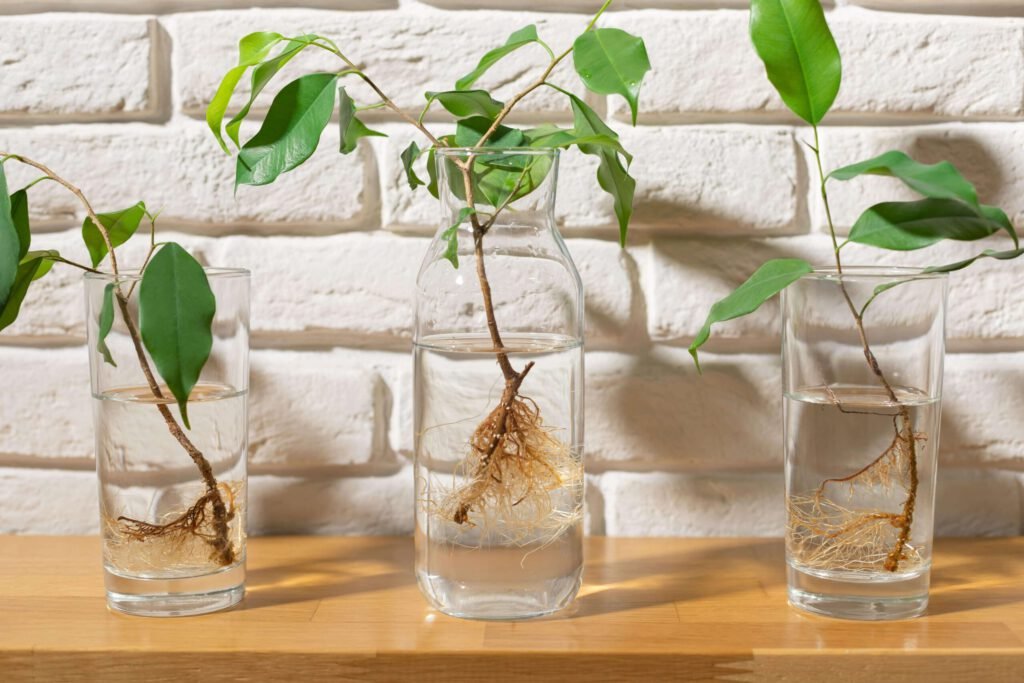
Water propagation lets you watch roots develop, making it ideal for beginners.
Use a clean glass jar with room-temperature water.
Only the node should remain submerged. Leaves sitting underwater usually rot.
Replace the water every three to five days instead of simply topping it off. Fresh water contains more dissolved oxygen, which encourages healthier root development.
Plants that usually root well in water include:
Pothos
Lucky bamboo
Philodendron
English ivy
Clear containers look attractive, but they also encourage algae growth if placed in direct sunlight.
I've learned that one the hard way.
Soil Propagation
Some species develop stronger root systems when rooted directly in soil.
Use a light propagation mix instead of regular garden soil. A common blend contains:
50% coco coir or peat moss
30% perlite
20% fine compost or vermiculite
The mixture should stay lightly moist—not soggy.
Overwatering kills far more cuttings than underwatering.
Step 4: Create the Right Environment
New cuttings lose water much faster than established plants.
Humidity becomes your friend.
Place cuttings somewhere with:
Bright, indirect light
Temperatures between 20°C and 26°C (68°F–79°F)
Moderate airflow
High humidity
Avoid direct afternoon sunlight.
Strong sun can cook an unrooted cutting within hours.
Many gardeners loosely cover pots with a clear plastic bag or humidity dome during the first couple of weeks. Just don't seal everything airtight. Open it occasionally to reduce fungal growth.
Step 5: Be Patient—but Keep Checking
Roots don't appear overnight.
Typical rooting times vary considerably.
Plant | Average Rooting Time |
|---|---|
Pothos | 2–4 weeks |
Coleus | 1–2 weeks |
Spider plant | 2–3 weeks |
Snake plant | 4–8 weeks |
Rosemary | 6–10 weeks |
Don't tug aggressively on cuttings every day to "check."
Instead, give them a gentle wiggle after a few weeks. Slight resistance usually means roots have begun developing.
Simple test. Reliable result.
Should You Use Rooting Hormone?
Not always.
Rooting hormone contains plant growth regulators called auxins, commonly indole-3-butyric acid (IBA) or 1-naphthaleneacetic acid (NAA). These compounds encourage root formation in many woody and slow-rooting species.
Soft houseplants like pothos often root perfectly without any hormone at all.
On the other hand, woody shrubs, fruit trees, and roses frequently benefit from it.
Just remember that more isn't better. Excess rooting hormone won't magically speed up growth.
Common Problems That Ruin Propagation
Propagation rarely fails because the technique itself is wrong.
It's usually something small.
Mushy stems
Almost always caused by excessive moisture or contaminated tools.
Start over with a fresh cutting.
Leaves turning yellow
Sometimes normal as the cutting redirects energy toward root production.
If multiple leaves collapse rapidly, however, inspect for stem rot.
No roots after several weeks
Possible causes include:
Cutting taken without a node
Temperatures below 18°C (64°F)
Too little light
Parent plant wasn't actively growing
Mold on the soil
Poor airflow is usually responsible.
Reduce humidity slightly and allow the surface to dry between light watering sessions.
Water vs. Soil: Which Produces Stronger Plants?
Gardeners debate this constantly.
Water propagation offers one major advantage: you can monitor root development without disturbing the plant.
Soil propagation usually produces roots already adapted to growing in a soil environment, reducing transplant shock later.
Here's a practical comparison.
Feature | Water | Soil |
|---|---|---|
Easy to monitor | ✓ | No |
Lower transplant shock | No | ✓ |
Beginner-friendly | ✓ | ✓ |
Less algae maintenance | No | ✓ |
Root strength | Moderate initially | Often stronger |
Neither method is universally superior.
Choose the one that suits the plant you're growing.
When to Move Your New Plant
Don't transplant too early.
For water-grown cuttings, wait until several roots measure approximately 5–8 cm (2–3 inches) long and secondary roots begin branching.
For soil propagation, look for healthy new leaves. Fresh top growth usually indicates the roots are established enough to support continued development.
After transplanting, keep the soil consistently moist for the first week while the young roots adjust.
A Few Tricks Experienced Gardeners Use
Not every useful tip appears on a plant tag.
Morning cuttings usually contain more stored moisture than late-afternoon ones.
Avoid fertilizing until roots are established. Excess nutrients can burn delicate new roots.
Label propagation trays with dates. It's surprisingly easy to forget when each batch started.
Rotate containers every few days if light comes from one direction to encourage balanced growth.
Don't crowd dozens of cuttings together. Better airflow reduces fungal issues.
Small habits. Noticeable results.
Frequently Asked Questions
Can every plant be propagated from cuttings?
No. Many popular houseplants root easily from cuttings, but others grow better through division, layering, grafting, or seeds. Research the preferred propagation method for your specific species before making cuts.
Is water propagation better than soil propagation?
Neither is automatically better. Water makes root growth easy to observe, while soil often produces roots that transition more smoothly into long-term growth after transplanting.
How long should cuttings stay in water?
Most gardeners transplant once several healthy roots reach about 5–8 cm (2–3 inches). Waiting too long can make adaptation to soil slower for some species.
Why are my cuttings rotting?
Stem rot usually results from overwatering, dirty tools, poor airflow, or leaves remaining underwater. Clean equipment and proper moisture levels dramatically improve success rates.
What's the easiest plant for beginners to propagate?
Pothos is one of the most forgiving choices. Philodendron, spider plants, coleus, and tradescantia are also excellent beginner-friendly options because they root quickly under normal indoor conditions.
Start Small, Then Experiment
One successful cutting changes how you look at gardening.
Instead of buying another plant, you'll start noticing healthy stems, spare offsets, and overlooked opportunities to grow your collection. Try a pothos or spider plant first, pay attention to clean cuts and proper moisture, and let the roots develop at their own pace. Confidence grows much the same way—one healthy propagation at a time.
plant propagation
propagate plants
plant cuttings
grow new plants
plant care tips
indoor plant propagation
gardening guide
propagate from cuttings
plant division
seed propagation
Found this helpful? Share it!